
Appearance
The Validation Protocol
Three falsifiable claims, frozen acceptance criteria, and negative controls that must fail.
Overview
| Claim | Question | Test |
|---|---|---|
| C1 — Noise integrity | Is the fitted noise model built from clean noise? | Purity checks on the background crop (static z-mean excess, marginal skew/kurtosis) |
| C2 — Structural integrity | Do the phantom's structures faithfully follow the inputs? | A corruption suite: 45 deliberate input/render defects, detection required for the harmful ones |
| C3 — Behavioral realism | Do denoisers relate to the pair as they relate to the real stack? | Three tiers: T1, T2, T3 (below) |
C3 carries the realism burden; C1 and C2 make sure it is tested on sound inputs.
C3: The Three Tiers
T1 — Residual Behavior
Classical denoisers (median-3, Gaussian-1, NLM, BM3D) run on the real stack and on the pair. Their residuals are compared on five statistics: residual sd, three spectral band fractions (0.005–0.08, 0.08–0.2, 0.2–0.5 cyc/px), and adjacent-slice correlation — judged against a measured real-vs-real envelope under a criterion frozen in advance:
amplitude gap(sd) ≤ 0.2 log₂ · band-character gaps ≤ max(2 × envelope, 0.2) · axial |Δzr1| ≤ max(0.05, envelope)
T2 — Training Transfer
Networks (N2V, structN2V) trained on the real stack must transfer to the pair within 2 dB of pair-trained models. If the pair's noise were meaningfully different, transfer would break.
T3 — Ranking Transfer
The benchmark's actual job: denoiser orderings must be preserved. On the development volumes, 88% of pairwise orderings are preserved through the pairs, versus 63% under white noise.
The Controls That Must Fail
- White noise at the correct amplitude: rejected in 30/30 cells
- The reduced v1 model (no axial correlation): rejected in 27/30 cells
If the protocol accepted these, it would prove nothing. It doesn't.
Failure-Inclusive Reporting
The strict T1 criterion passes 9 of 30 cells; at the loosest relaxation that still rejects every white-noise cell, 17 of 30. Every miss is diagnosed and mapped to a model consequence — three noise-model revisions were each forced by such a measurement, the last moving exactly the statistic it was predicted to move.
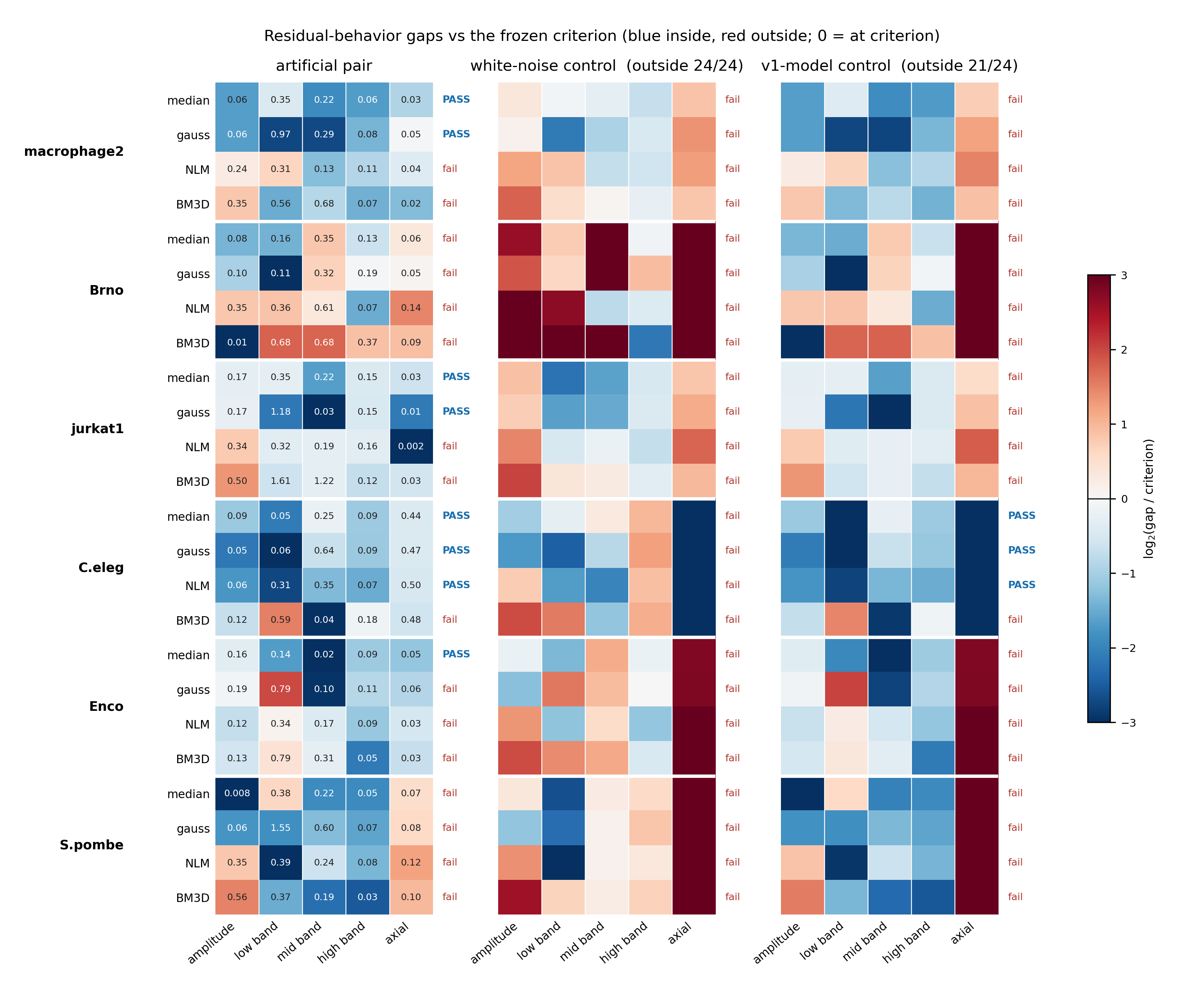 The failure-inclusive T1 scoreboard across volumes and denoisers, with the negative controls
The Held-Out Test
A seventh volume, untouched during development, closed the loop under a pre-registered protocol. Real-data quality was measured against an even/odd frame-split half-data reference (the Noise2Noise argument), giving a ground-truth-free ranking of seven denoisers on real data:
| Benchmark | Pairwise orderings preserved | Kendall τ |
|---|---|---|
| PhantEM pair | 10 of 12 | +0.67 |
| White-noise pair | 2 of 14 | −0.71 |
The same conclusion in one line: the PhantEM pair predicts how denoisers rank on real data; a white-noise benchmark nearly inverts it.
Running the Tiers Yourself
The scripts that produced the published scoreboard ship in validation/:
bash
python validation/ws_render_stacks.py            # step 1: render pairs + negative controls
python validation/ws_t1.py                       # step 2: classical tier
python validation/ws_t2_careamics.py             # step 3: ML tier (careamics + torch needed)
ws_common.py holds the volume registry, evaluation windows, metrics, and the frozen verdict(). phantom_qc.py is the C2 corruption suite; tune_check.py gives a fast per-volume scorecard while tuning.
Related
- Realism, Not Recreation — why the protocol is designed this way
- The Benchmark Data — the published, scored pairs