
Appearance
PhantEM
Realism-validated synthetic benchmark pairs for denoising volumetric electron microscopy.
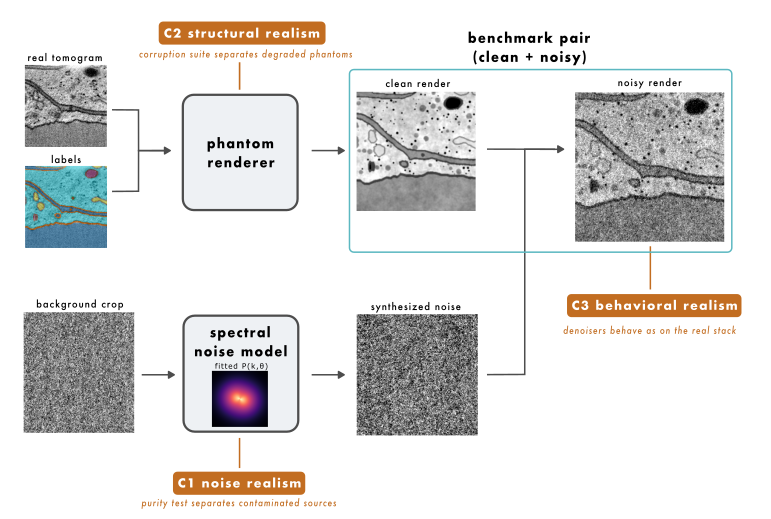 From a real acquisition to a validated benchmark pair: phantom rendered from the volume's own segmentation, noise fitted to its own background
The Problem
Denoising methods for volumetric EM are routinely evaluated on synthetic data whose resemblance to real data is asserted rather than measured. Real cryo-ET and FIB-SEM volumes have no clean counterpart to score against — and their noise is spatially correlated, anisotropic, and correlated between slices, none of which white noise reproduces. A benchmark built on unrealistic noise can invert the ranking of the very methods it is supposed to compare.
The Solution
PhantEM generates benchmark pairs in which both halves are anchored to a real acquisition:
- The clean volume is a phantom rendered from a real tomogram's own segmentation — per-class intensities measured from the volume itself, tunable object populations, membrane bands, PSF.
- The noise is a parametric spectral model (anisotropy, banding, axial correlation) fitted to background crops of the same stack by a contamination-tolerant estimator.
The claim is deliberately realism, not recreation: the pairs are not reproductions of a specific stack's noise, but stacks with realistic noise and structure — close enough that behavioral conclusions transfer.
Validation, Not Assertion
A three-claim protocol makes realism falsifiable:
| Claim | Test | Headline result |
|---|---|---|
| C1 — Noise integrity | Purity test separating clean from contaminated noise sources | p < 10⁻⁵ |
| C2 — Structural integrity | Corruption suite of 45 deliberate defects | 38/45 harmful corruptions detected |
| C3 — Behavioral realism | Denoisers must relate to the pair as they relate to the real stack | T1 residual behavior, T2 training transfer (within 2 dB), T3 ranking transfer (88% of pairwise orderings vs 63% under white noise) |
Every test ships a negative control that must fail: white noise at the correct amplitude is rejected in 30/30 cells, and a reduced axially-uncorrelated model in 27/30. Acceptance criteria were frozen before the tiers ran, and the scoreboard is reported failure-inclusive. On a seventh, held-out volume, denoiser rankings transfer through the pair (Kendall τ +0.67) while a white-noise benchmark nearly inverts them (τ −0.71).
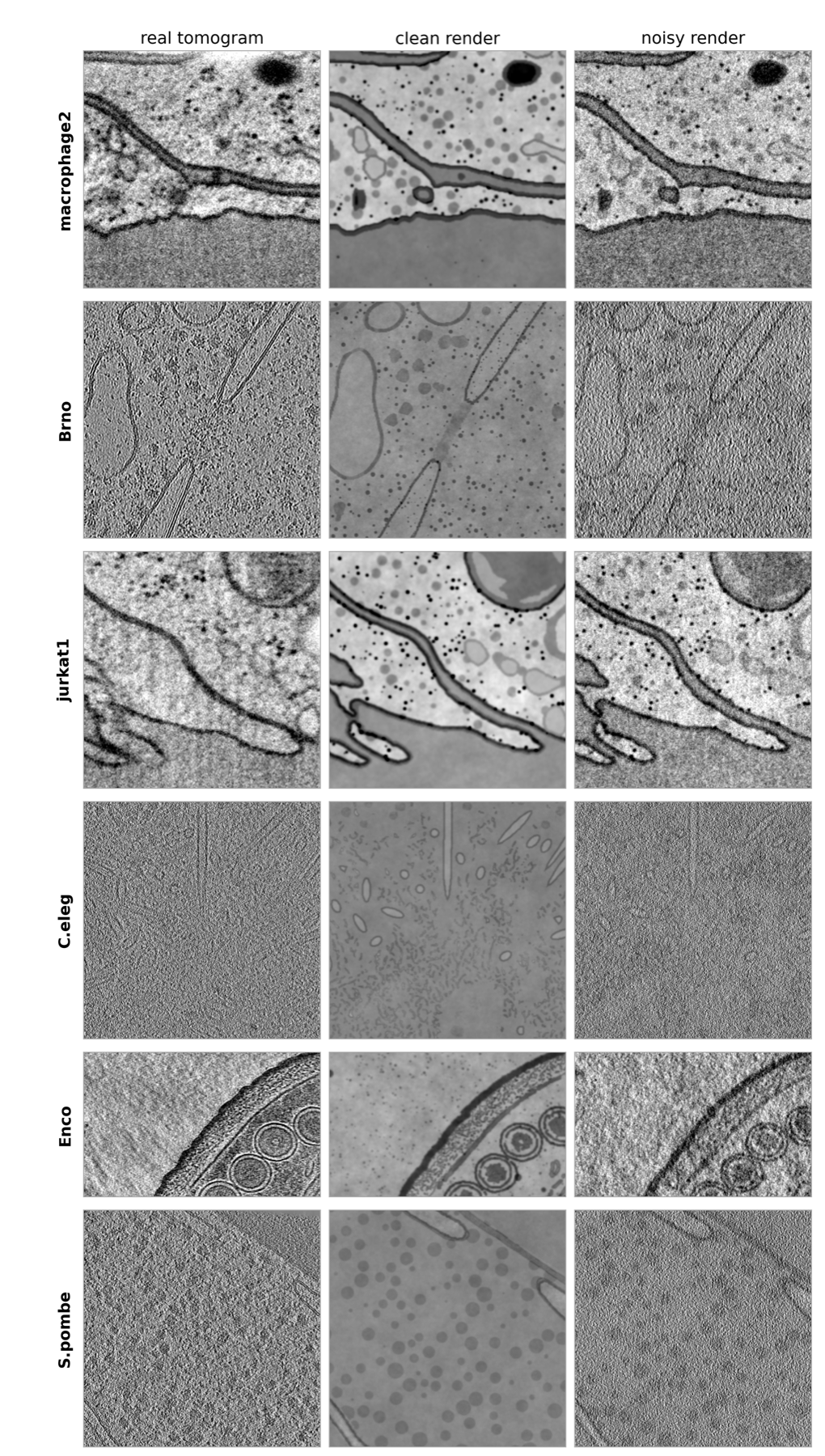 The benchmark pairs: real slice, clean phantom, and noisy phantom for each volume
What You Get
- Seven published pairs (six development + one held-out) with clean/noisy stacks, labels, frozen configs, background crops, fitted noise models, and evaluation windows — on Zenodo, DOI 10.5281/zenodo.22084921 (CC-BY-4.0)
- The renderer: an interactive tuning workbench plus headless tools to build a matched phantom from your own tomogram + segmentation + background crop
- The validation scripts that scored the published pairs — rerunnable on yours
Documentation
Getting Started
Install the renderer and open your first volume
Tuner Workbench
The interactive phantom-building UI
Tutorial: Your Own Volume
From tomogram + labels + crop to a matched pair
The Benchmark Data
The seven pairs, sources, and licences
Concepts
| Concept | Description |
|---|---|
| Realism, Not Recreation | What PhantEM claims, and what it deliberately does not |
| The Noise Model | Spectrum, banding, and axial correlation, fitted from background crops |
| The Validation Protocol | C1/C2/C3, frozen criteria, negative controls |
Availability
- Code: github.com/lucasfortune/phantem (BSD-3-Clause, results at tag v1.1)
- Data: Zenodo 10.5281/zenodo.22084921 (CC-BY-4.0)
- Paper: preprint link coming soon
- PhantEM is the benchmark behind the AutoStructN2V evaluation